

Water damage is the most common insurance claim in multifamily housing. The average claim runs $13,954, and multifamily insurance premiums have jumped over 43% year over year in many markets. Meanwhile, municipal water data shows that 14% of residential water usage goes to leaks, and that number can run much higher in older or larger properties.
For property managers and building owners, the question isn't whether water waste is costing you money. It is. The question is whether a monitoring system pays for itself, and how fast.
The short answer: most properties see a full return within 3 to 6 months.
What a Water Monitoring System Actually Costs
One of the biggest misconceptions about water monitoring is that it requires a massive capital investment. In reality, modern systems like NOWi's are designed to be lightweight and low-friction.
No plumbing modifications required. Devices strap onto existing pipes or meters in seconds.
No WiFi dependency or IT infrastructure needed.
No professional installation crews. Your maintenance team can handle setup.
Battery-powered devices with multi-year battery life and minimal upkeep.
A 100-unit apartment building typically needs just a handful of devices depending on plumbing layout -- one on the main water meter and additional units on high-risk branch lines. Compare that modest investment to a building that likely spends $40,000 to $80,000 a year on water, and the math starts to look very favorable.
That's a meaningful difference from systems that require pipe cuts, dedicated network infrastructure, or professional installation crews. Contact us for a custom quote based on your building's specific needs.
The Four Drivers of ROI
Water monitoring pays for itself through four distinct channels. Most properties see savings from all four simultaneously.
1. Leak Detection: Avoiding Catastrophic Losses
Manual inspections miss an estimated 90% of hidden leaks. Those leaks sit behind walls, above ceilings, and under slabs until the damage becomes visible, at which point repair costs have already escalated dramatically.
A single running toilet can waste $240 per month. A burst pipe affecting multiple floors in a multifamily building can generate claims in the tens of thousands. Water damage affects 14,000 people daily across the U.S.
Real-time monitoring catches anomalies within minutes, not months. In one NOWi deployment across 24 San Francisco buildings, 11 out of 24 properties had active leaks, including 3 with leaks exceeding $1,000/month. None of them had been detected before monitoring was in place.
2. Reduced Water Bills
Where does all that water actually go? According to the City of Winnipeg's Water and Waste Department, leaks account for 14% of all residential water use, making them the fourth largest category of consumption, ahead of dishwashers, baths, and other combined uses.
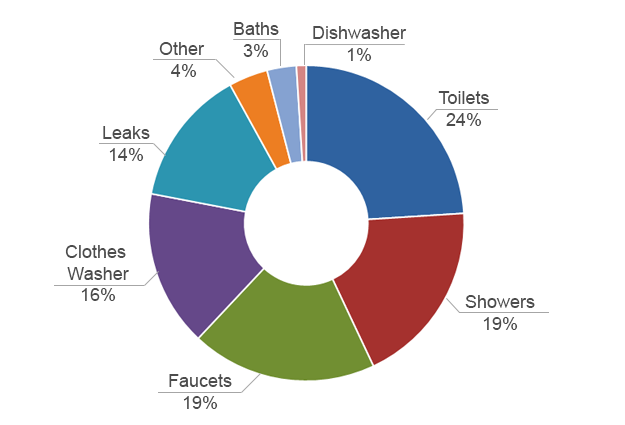
The EPA estimates that the average household leaks 10,000 gallons per year. Scale that to a 100-unit building, and you're looking at significant waste that flows directly into your utility bill every month.
NOWi's minute-by-minute data shows you exactly where water is going. Property managers routinely discover usage patterns they didn't know existed: irrigation systems running during rain, cooling towers cycling inefficiently, or units with chronically running fixtures.
Industry data consistently shows that properties implementing smart water monitoring reduce consumption by 15% to 30%. On a building spending $60,000 annually on water, that's $9,000 to $18,000 back in your pocket every year.
3. A Stronger Position at Insurance Renewal
Insurance carriers are paying close attention to water risk. Multifamily premiums have spiked, with some markets seeing increases above 50% year over year. Some insurers now require smart leak detectors for certain policy types.
While premium reductions aren't guaranteed, demonstrating proactive water management during renewal conversations puts you in a stronger negotiating position. It's one more data point in your favor when your broker is making the case to underwriters. Some property managers have reported favorable terms after showing active monitoring data, but the bigger win here may simply be avoiding the claim that triggers a rate hike in the first place.
4. Increased Property Value Through NOI
Every dollar you save on water and avoid in damage repairs flows directly to your Net Operating Income. In commercial real estate, NOI drives property valuation.
If your building trades at a 5% cap rate, every $1 increase in NOI adds $20 to property value. Saving even $10,000 a year on water and damage prevention translates to a $200,000 increase in building value at that cap rate. That's a meaningful number from a relatively modest monitoring investment.
Sample ROI Calculation: 100-Unit Apartment Building
Here's a conservative scenario based on real deployment data.
| Category | Annual Impact |
|---|---|
| Annual water spend (before monitoring) | $60,000 |
| Water bill reduction (20% savings) | $12,000 |
| Avoided water damage event (1 moderate incident) | $15,000 |
| Total annual savings | $27,000 |
| Typical monitoring system cost (Year 1) | A fraction of one month's water bill |
Even if you cut these estimates in half, you're looking at a payback period measured in weeks, not years. The system cost is a small fraction of what most buildings spend on water annually, and ongoing costs drop further after the first year.
What Real Deployments Look Like
The numbers above aren't theoretical. Here are results from actual NOWi deployments.
Portfolio Owner A: 24 Buildings in San Francisco
A property owner deployed NOWi monitors across 24 buildings ranging from 24 to 88 units each. Most buildings needed just one device. The results: 3 buildings had leaks costing over $1,000/month, another 8 had leaks between $100 and $1,000/month, and 11 buildings came back clean. The total waste identified across the portfolio was 345,000 gallons per month, or $11,040 per month in water and sewer costs at San Francisco's rate of $0.032/gallon. ROI on the monitoring investment: under 2 months.
Portfolio Owner B: 27 Smaller Buildings
A second owner deployed across 27 buildings of 9 to 20 units each. Same pattern: 2 buildings had leaks exceeding $1,000/month, 5 more had leaks between $100 and $1,000/month. Total waste: 159,000 gallons per month, or $5,100/month. Again, full ROI in under 2 months.
Beyond the Spreadsheet
ROI calculations capture the financial picture, but some benefits are harder to quantify and equally important to operations:
Faster repairs, less wasted labor. Without monitoring, your maintenance team chases leaks blind. They fix something, then wait 30 to 60 days for the next water bill to see if it worked. With real-time data, they can confirm a repair is successful the moment it's done. That eliminates repeat truck rolls, cuts diagnostic time, and lets your team move on to the next priority with certainty instead of guesswork.
Know exactly when a leak starts, and why. Timestamp data makes root cause obvious. If water usage spikes every Tuesday at 2 PM, that's the pool service. If consumption jumps overnight on a holiday weekend, that's a toilet flapper or a burst pipe, not tenants taking long showers. When you can pinpoint exactly when anomalous usage began, you stop chasing false leads and go straight to the source.
No more 3 AM emergency calls. Real-time alerts mean you catch problems during business hours, before they become emergencies that pull your maintenance team out of bed.
Tenant retention. A 2025 Rently survey found that 58% of renters would give up traditional amenities like pools and gyms in favor of smart technology in their building. A property that proactively prevents water disruptions is a property tenants want to stay in.
ESG and sustainability reporting. Water conservation data from your monitoring system feeds directly into environmental reporting, a growing requirement for institutional investors and an expectation from municipal regulators.
Getting Started
The barrier to entry for water monitoring is lower than most property managers expect. There's no construction, no plumber, no network infrastructure to install. NOWi's devices work on cellular IoT, so they operate independently of your building's WiFi and start reporting data within minutes of installation.
Most properties begin with a device on the main water meter to establish a baseline, then add Pipe Monitors to high-risk areas as the data reveals where attention is needed. It's a phased approach that lets you prove ROI before scaling.
Ready to see what water waste is costing your building?
Request a Free Water Assessment →